Cultural Exchange, Cultural Appropriation

Jarune Uwujaren, on Everyday Feminism, dispels the confusion around when something represents sincere exchange between cultures and when a culture is being destructively appropriated for another’s consumption. While acknowledging that the line is easily blurred, Uwujaren begins with introducing principles to keep in mind when evaluating which side a behavior falls on.

“One of the reasons that cultural appropriation is a hard concept to grasp for so many is that Westerners are used to pressing their own culture onto others and taking what they want in return. We tend to think of this as cultural exchange when really, it’s no more an exchange than pressuring your neighbors to adopt your ideals while stealing their family heirlooms.”

Mutual understanding, equality, and respect should guide any legitimate exchange.

Read more here.

Power Girls

“Powerful girls grow up feeling secure in themselves. They learn to take action, making positive choices about their own lives and doing positive things for others. They think critically about the world around them. They express their feelings and acknowledge the feelings and thoughts of others in caring ways. Powerful girls feel good about themselves and grow up with a “can-do” attitude. Of course, strong girls may (like all of us) have times of insecurity and self-doubt, but these feelings aren’t paralyzing because the girls have learned to work through their problems. Powerful girls will grow up to lead full, valuable lives.

Here are some of our experts’ ideas to help you raise powerful daughters.”

Read the article here.

#WickedPissed

Gay pride parades are not always the most inclusive events, often focusing primarily on the most privileged members of the community. As part of an attempt to highlight within-community oppression, activists in Boston disrupted the parade for eleven minutes.

“The sit-in served to refocus attention on those most marginalized in the LGBTQ community, honor the lives of trans women of color, and raise awareness to the lack of representation and resources available to LGBTQ people of Color in Boston. The sit-in intentionally lasted for 11 minutes to symbolize the 11 lives of transgender individuals who have been beaten down, slaughtered, and brutally murdered in the United States this year. Every two days, somewhere in the world, a trans woman of color will be murdered! Today, we act to disrupt pride for eleven minutes to honor and bring awareness to the lives of each trans person murdered this year.”

Read the article and the activists’ statements here.

Be Where You Are

I’m learning a new song on the piano – it’s one of the hardest and most beautiful songs I’ve ever tried to play, and I have dreamed of playing it ever since I first heard it. I’ve had the sheet music for it since then, but its complexity and majesty have made it difficult for me to pick through and learn.

My brother is getting married in a week, and I have the most incredible vocalist  a pianist could dream of, so I decided it was time to tackle it. I even went so far as to add to it, bringing my favorite sax player in on it to make it even more powerful. It’s a big mountain to climb. It’s been frustrating.

I’ve pushed through with practicing, and can make it through the whole song in super-slow-motion, with a few stops and starts along the way. I feel victorious when I start at the beginning and end at the end, even if the middle is a mess. But I’ve noticed something.

Every time I stop playing I say (either out loud or in my head)

“That was awful!”
“I’m never gonna get it!”
“I’m so bad at this!”

______________________________________________

I’ve had mixed experiences with yoga throughout my life, but have particular difficulty with it now because of chronic muscle spasticity problems. There are significant limits to what I can do in a yoga practice, and I’m usually pretty self-conscious in a yoga class because I can’t ever keep up.

But I’m working at a yoga studio now, and have supportive awesome people around me, so I’m giving it a shot. I started Monday, and spent half the time in child’s pose because I couldn’t do what the class was doing. The other half of the class I was able to do at least an approximation of the poses, and the instructor gave me lots of modifications and encouragement, so I didn’t feel as self-conscious as I have in the past.

When I made it from the beginning of class to the end, I felt victorious, even though the middle was a mess. But I noticed something.

In my head, I was thinking

“That was awful!”
“I’m never gonna get it!”
“I’m so bad at this!”

______________________________________________

This week I’ve been thinking about what it means to be where I am. I realize that the only way I won’t be terrible at something is if I give myself permission to be terrible at it for a while. I have to let myself be a beginner.

But, if I am terrible at them for a while, and my inner voice is trying to convince me that being terrible is a bad thing, then why on earth would I want to keep doing these things? Both activities are difficult, so if it’s not an enjoyable experience, where does the motivation to do the hard work come from? I might as well have my childhood piano teacher with the mean pointy fingernails standing over my shoulder scolding me (at the piano OR at yoga – equally terrifying).

______________________________________________

So now I’m practicing challenging that voice. Every time the thought enters my head to say something negative, I’m going to yell an opposite response as loud as I can (in my brain, not out loud).

“I’m getting it!”
“One step at a time!”
“This is great!”
“I can tell I’ve improved!”
“Just make it to the end!”
“I am doing just fine!”

With that said, I’m also going to allow myself to feel frustrated. It’s hard. I get aggravated. Those feelings are valid too, and I don’t want to squash them with false positivity. So when it’s hard, I’m going to say that in a way that doesn’t de-value my work and my effort.

“I’m so frustrated!”
“Whyyyyyyyyy does it have to be so haaaaaaaard!”
“GRRRRRRR!”
“I hate this arrangement/pose!!! I’m just gonna improvise!!”
“Hand me that gallon of ice cream please!!”

So that’s what I wanted to share with you today. Wherever you are, whatever you’re doing, you’re doing fine. Allow yourself space to be terrible in order to get better. Celebrate your progress, don’t question it. Challenge the voice that tries to undermine your effort.

Be where you are.

7 Talks on the Trans Experience

Hailey Reissman has gathered seven different TED/TEDx talks to highlight the difference in every Trans person’s individual, lived experience.

“Alice Miller was born in a body that didn’t feel like hers. Every day, Yee Won Chong has to debate whether to use the men’s restroom or the women’s. Geena Rocero found success as a fashion model — but kept her birth gender a secret for nearly a decade, fearing what others would think.

All these people have transitioned into their true gender. And all of them made the decision to share their stories in a TED or TEDx talk. What these seven stories show: There is no one “right” way to live a life. And no one should have to spend a life hiding who they are.

Below, seven talks on living life expressing your true gender:”

Watch all 7 talks here.

The Inner Voice (Part 1/3)

I want to ask you now to think about that little voice in your head, the one that keeps up the constant narration throughout your day. Have you noticed it before?


“Where did I put my keys? Damn, this is the third time I’ve lost them this week, what’s the matter with me! If I can’t keep up with keys, how could I keep up with my new job? I hope there’s nothing surprising today, I’m not sure I could handle it….”

As you go about your regular life, you have probably become somewhat sensitized to that voice, so much so that you may not even realize that it’s there.

What is your inner voice telling you right now, as you read this?

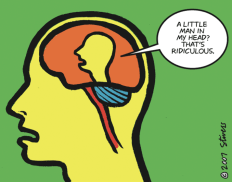
the gracious mind man inside head“I don’t know what she’s talking about, I don’t have an inner voice. Yes I do, that’s what I’m hearing in my head right now. But I don’t think I have it all the time. Maybe I do? I don’t know…”

Your inner voice likes to argue with itself. It doesn’t mind taking both sides in an argument. The voice just wants to keep talking.

Think about when you’re trying to sleep, and the voice just chatters away. Non-stop, all the time. Sometimes you’re trying to focus on something you enjoy doing, but can’t quite get past the inner dialogue. Occasionally, you might even try to do something just to shut the voice up, like having a drink or distracting yourself with a movie.

It can be easy to think that the inner voice is telling you the truth. It feels like it’s you talking, because it’s in your head, and so it’s easy to think that it has to be right. But if you really think about it, that inner voice is wrong fairly often. That’s the voice that has misunderstood people in the past, it’s the voice that told you you’d fail when you succeeded, and it’s the voice that has made you feel badly about yourself in ways you’ve never deserved.

That’s because the voice isn’t actually you.

It’s basically one big mashed-up mess, an amalgamation of all the voices throughout your life that have impacted you. It’s the people who were and are around you, it’s all the movies and tv and ads you’ve ever seen, it’s the media coverage of current events, it’s every teacher you’ve ever had – add them all up, and that’s the voice you’re hearing in your head. That voice is not you.


“I want to go to the party, but I know everyone is going to ignore me. They’re not even going to notice if I’m not there. But she invited me so she must want me there. But maybe she just invited me to be nice. Some people do that. I don’t think she would do that. I think I’ll just go and see. Or, I could order pizza and stay home.”

the gracious mind the monster in your head

“I AM THE VOICE!!”

So your first task is to start to notice the voice as if it is separate from you. Imagine a little fluffy monster in your head that’s just chattering away. Don’t argue with it, don’t try to change it, I just want you to notice it, and recognize two things:

1) the voice will do anything to keep talking

2) the voice is not always right

Here’s your homework: just notice. 

Spend a day or two just listening to the voice and making note of what kinds of things the voice is saying. Good, bad, self-deprecating, neutral, nagging, doubting, encouraging – whatever the voice is saying, just notice it. Once you feel like you have a good sense of your inner voice, check back here for part 2.

Creative Decline

Dr. Peter Gray, professor at Boston College, brings us this article (with citations) on the impact of increasingly rigid classroom expectations.

“Creativity is nurtured by freedom and stifled by the continuous monitoring, evaluation, adult-direction, and pressure to conform that restrict children’s lives today.  In the real world few questions have one right answer, few problems have one right solution; that’s why creativity is crucial to success in the real world.  But more and more we are subjecting children to an educational system that assumes one right answer to every question and one correct solution to every problem, a system that punishes children (and their teachers too) for daring to try different routes.  We are also, as I documented in a previous essay, increasingly depriving children of free time outside of school to play, explore, be bored, overcome boredom, fail, overcome failure—that is, to do all that they must do in order to develop their full creative potential.”

Read the full article here.

Talking Trans

Writing in the context of how mass media failed to show basic respect for trans lives, Thu-Huong Ha gives a brief guide on appropriate ways for people to discuss these topics, which deserves revisiting after the high profile introduction of Caitlyn Jenner to the public.

Read more here.

Image by Ray Lee

Kalief: In Memoriam

Jennifer Gonnerman delivers a beautiful rendering of a tormented life. After three years at Rikers without a trial, Kalief Browder has died by suicide.

“Ever since I’d met him, Browder had been telling me stories about having been abused by officers and inmates on Rikers. The stories were disturbing, but I did not fully appreciate what he had experienced until this past April when I obtained surveillance footage of an officer assaulting him and of a large group of inmates pummeling and kicking him. I sat next to Kalief while he watched these videos for the first time. Afterward, we discussed whether they should be published on The New Yorker’s Web site. I told him that it was his decision. He said to put them online.

He was driven by the same motive that led him to talk to me for the first time, a year earlier. He wanted the public to know what he had gone through, so that nobody else would have to endure the same ordeals. His willingness to tell his story publicly—and his ability to recount it with great insight—ultimately helped persuade Mayor Bill de Blasio to try to reform the city’s court system and end the sort of excessive delays that kept him in jail for so long.”

Read the whole article here.